The blueprint · tap any building
PROJECT JUPITERForce Upgrade BLUEPRINT
Their buildings, their fence, their site. Same timeline. Here is what we would add, drawn so you can play with it.
The same site in 5 years: their plan vs. the upgrade
The real Jupiter has a storm bigger than Earth that has raged for centuries. Left: the project as filed, with its permitted plume growing every year it runs. Right: the same project upgraded. Satire, and our own drawing on the right; nobody is claiming anything about the planet.

THE SITE, THEIRS AND UPGRADEDForce Upgrade
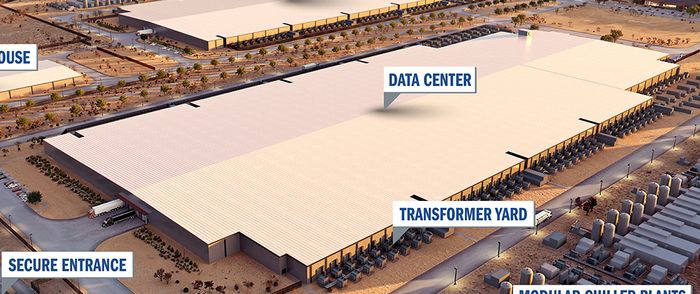
Layout source: Project Jupiter Together's labeled site render dated Aug. 27, 2026, from their media gallery [6]. It is the only site drawing the developers have published; no top-down plan has been released. The signed Community Benefits Agreement describes a site of about 819 acres with a 400-acre first phase [1]; the render shows that phase. Positions are read from the image and are not survey-accurate.
This layout is the closest approximation we could draw from the one photo the developers have published. It is a mock-up, not a survey.
Tap any building to open it full-screen.
Where this layout comes from, and what sits inside the fence ▾
Layout source: Project Jupiter Together's labeled site render dated Aug. 27, 2026, from their media gallery [6]. It is the only site drawing the developers have published; no top-down plan has been released. The signed Community Benefits Agreement describes a site of about 819 acres with a 400-acre first phase [1]; the render shows that phase. Positions are read from the image and are not survey-accurate. Drone view straight down, north up. The security fence encloses only the halls, the chiller plants and the dry coolers; the warehouse, Operations and parking sit outside it on the west, with the secure entrance and secure exit as gates in the fence and the guard booth on the public road. Inside the fence: a dry-cooler band across the north, a loop road under it running from west of the warehouse to the east edge and back down, two halls in the north row split by a pair of roads, a cross road, the main hall with a smaller hall east of it split by a centre road and ringed by a service road, three chiller plants and three units below, and a dry-cooler band across the south. Two more roads run between the warehouse and the west hall. No building touches a road.
Greenhouses, Phase 1 (proposed)
How it should be done ▾
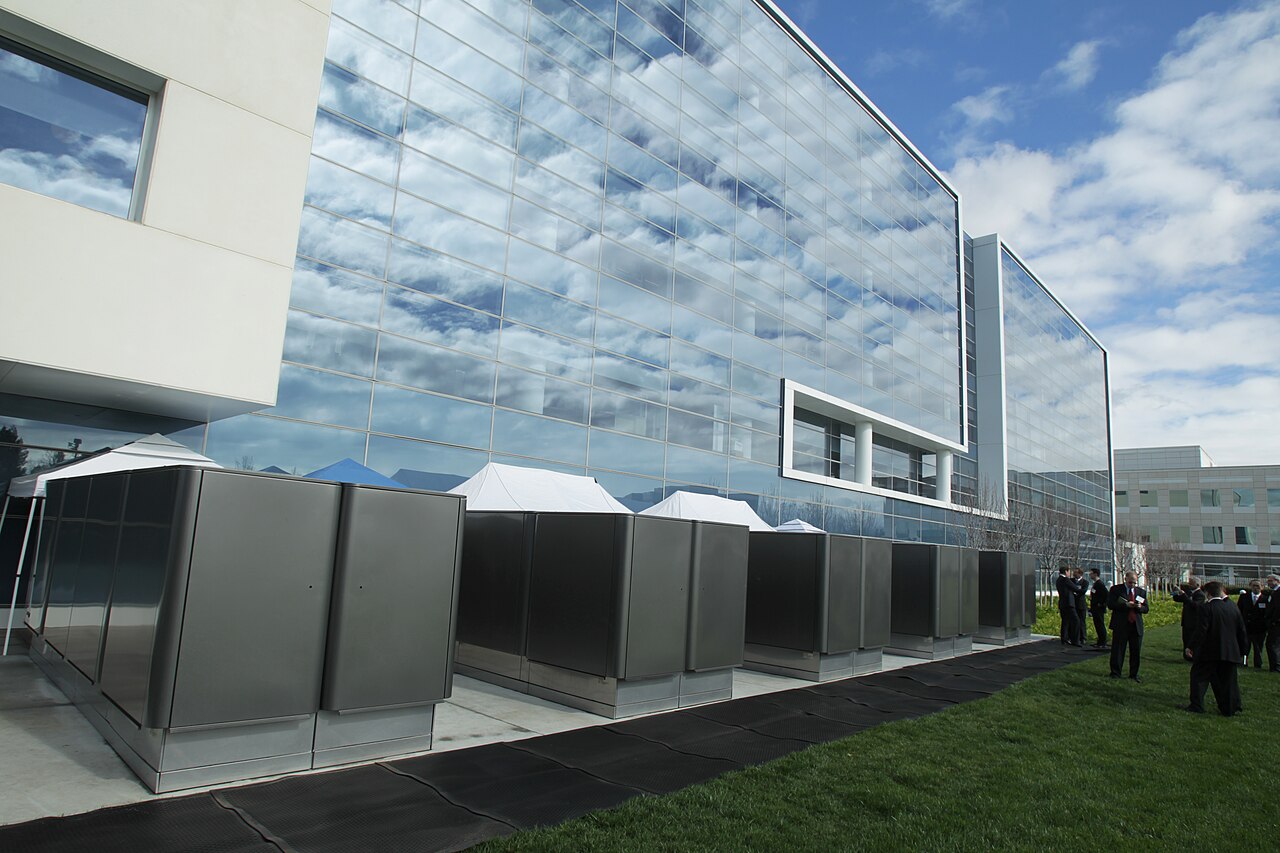
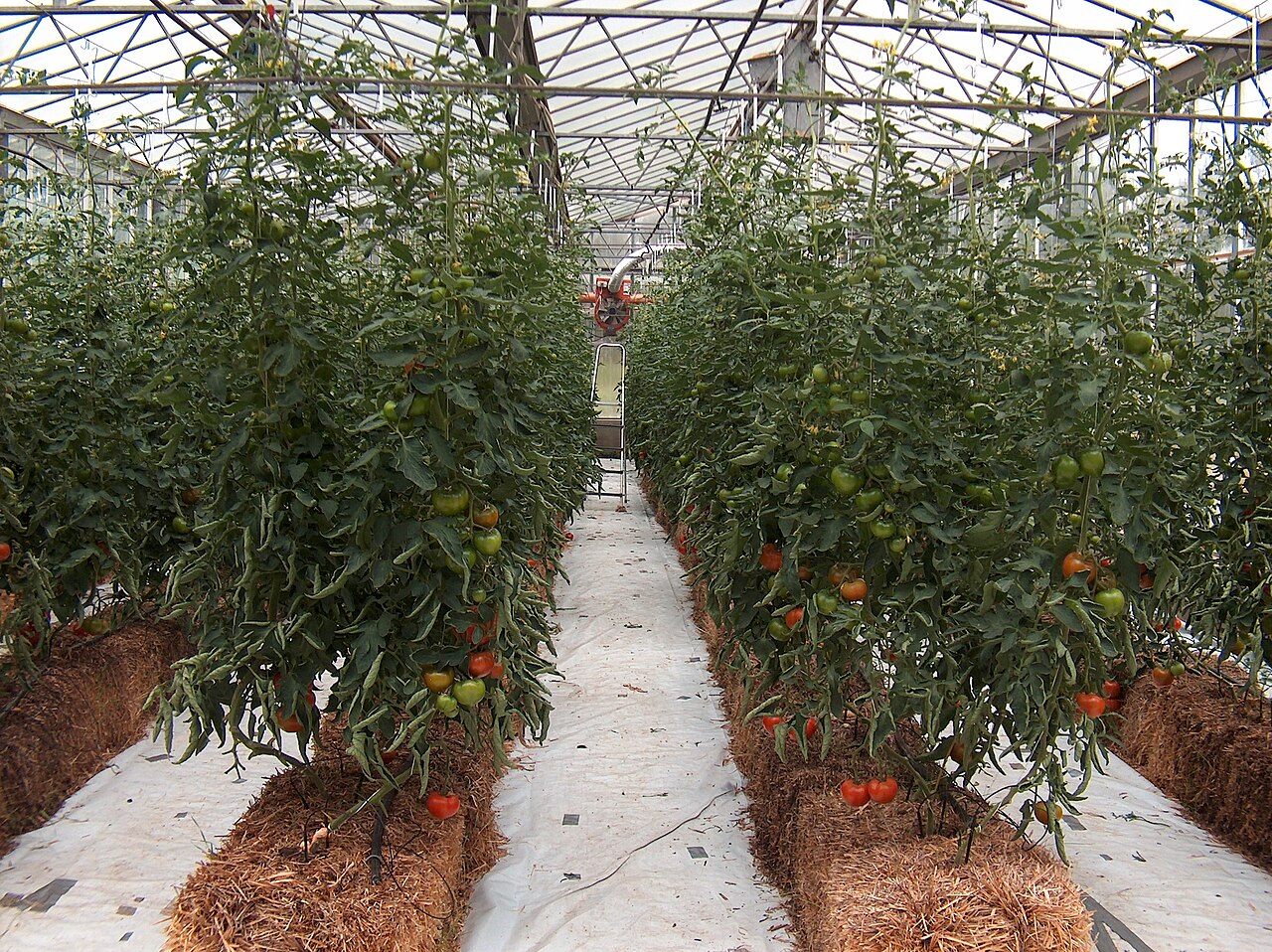
150 acres of glass hydroponic bays directly south of the dry coolers, inside the extended fence, run by commercial growers who lease the land. About a quarter of the roof carries semi-transparent solar. About 60 million pounds of food and 1,000 jobs a year.
Their plan for this land ▾
Open desert inside the property.
Acre budget: how the ~819 acres are used ▾
Their original text for this section is hidden ·
THE PROCESSESUpgrade
Five things happen on this campus that their site does not explain. Each one below is a real machine with real limits. The sliders show the limits too. A plan that leaves them out is a plan that gets thrown out.
Words used on this page · tap to open
- MW
- One megawatt is a million watts, a rate of energy flow. As heat, 1 MW is about 38 home gas furnaces running flat out. As electricity, 1 MW is roughly what 750 U.S. homes draw on average. The campus needs 2,462 MW of electricity and throws off about the same in heat.[44][45][4]
- MGD
- Million gallons per day, the standard unit for water plants. 1 MGD is about the daily use of 3,300 homes at 300 gallons a home.[46]
- tons/yr
- Tons per year is how air permits count pollution. A ton is 2,000 pounds; a full dump truck carries about 10 tons.
- ppb
- Parts per billion. The health standard for ozone (smog) is 70 ppb averaged over 8 hours; above that, EPA says lungs are being harmed.[47]
- µg/m³
- Micrograms per cubic meter, the unit for fine particles (PM2.5). The health standard is 9 µg/m³ averaged over a year.[48]
- CO₂e
- Carbon-dioxide equivalent. Methane and other gases are converted to the amount of CO₂ that would warm the planet the same amount, so one number covers them all.
- capture efficiency
- Not the same as purity. Purity (about 95%) is how much of the exhaust is CO₂. Efficiency (90–95%) is how much of that CO₂ the unit removes. Whatever it misses is released.[3][15]
- brackish
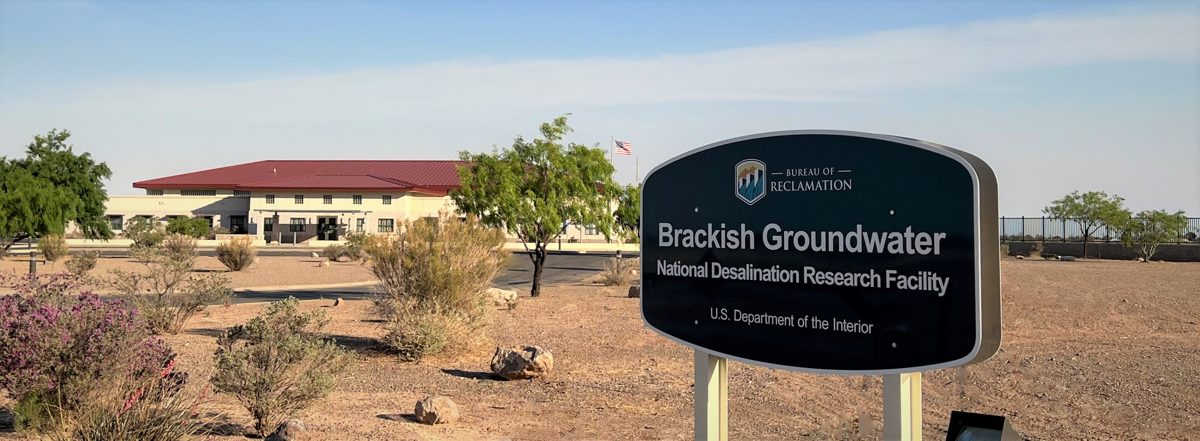
- Water with 1,000 to 10,000 milligrams of dissolved salt per liter. Seawater is about 35,000. It looks clear; the salt is dissolved.[19]
- PSD
- A federal permitting review that applies when a plant emits 250 tons a year or more of a pollutant. It requires the best available controls. The filed permit keeps each pollutant just under 250 tons, so the review is not triggered.[3]
- Title V
- Title V of the Clean Air Act: the operating permit every major source must hold, with monitoring and public reporting.[3]
- nonattainment
- EPA's label for an area whose air fails a health standard. Sunland Park has been an ozone nonattainment area since Aug. 3, 2018.[49]
- acre-foot
- An acre-foot is 325,851 gallons, about what three homes use in a year.
- IRB
- Industrial revenue bonds. The county holds title to the project and leases it back, so the developer pays negotiated payments instead of property tax for 30 years. The lease is the county's enforcement tool.[1][12]
- CBA
- The Community Benefits Agreement signed Nov. 12, 2025. It sets the binding jobs (750 full-time), the water cap, the $11.4M in programs and the site size (about 819 acres).[1]
Where the heat goes
Net gain for humanity ·free heat that was going to the sky now grows food in winter and makes cooling in summer.
How can heat make cooling? And is there a winter here? ▾
How heat makes cooling: an absorption chiller runs on hot water instead of electricity, the way a propane camping fridge does. And winter is real here: Santa Teresa nights drop into the 20s and 30s °F from December to February, so a greenhouse needs root heat on every cold night from November to March. This is not about making more power: the heat is already there and free. Their plan blows it into the sky; ours puts it to work so 150 acres of greenhouses grow food year-round. The gain is measured in food and jobs, not megawatts.
Tap any part of the drawing for what it is and a photo. NEW marks what the upgrade adds.
This bar is all the heat the computers make, and where it goes
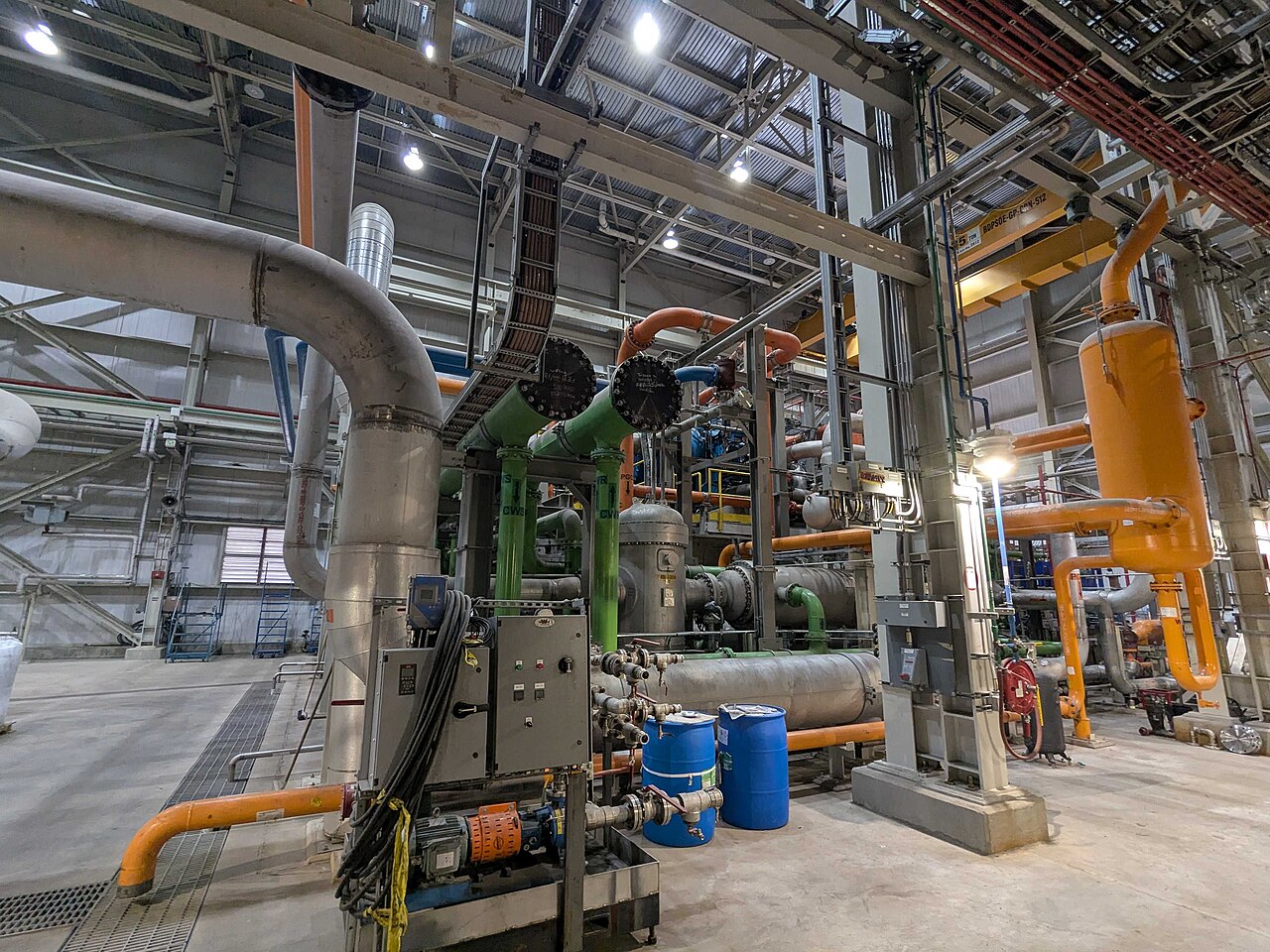
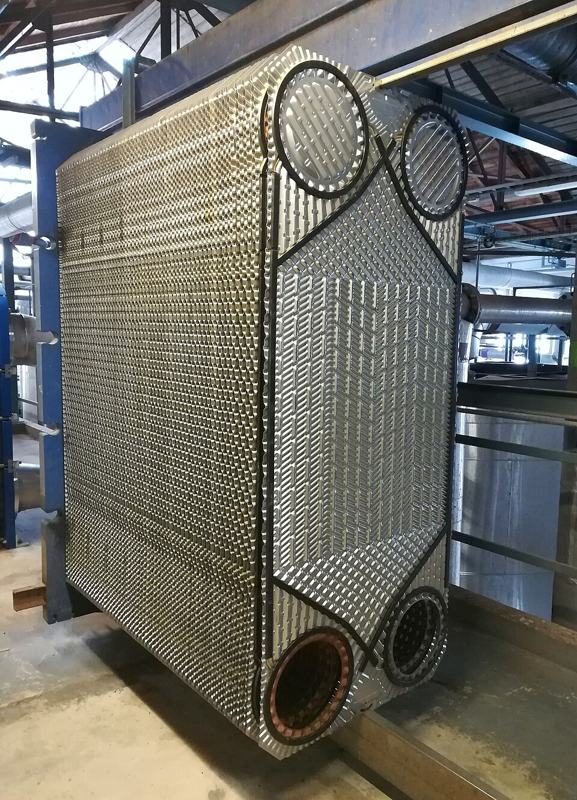
In summer the same heat can drive absorption chillers, standard hardware that makes cold from 65–100 °C water at a coefficient of performance near 0.86, cutting the electric chiller load[69][70]; that is an estimate for this site, not a design. A megawatt (MW) is a rate of energy, like miles per hour is a rate of distance. To make it concrete we translate every MW into home furnaces: a typical furnace is rated about 90,000 BTU per hour, so 1 MW ≈ 38 furnaces[44]. Rough equivalences, labeled as such. Heat ≈ IT load is thermodynamics, not a measured figure. Greenhouse acreage is a proposal; the site is about 819 acres with 400 in the first phase[1].
Not written for you? Change reader ↑
Sources for this process (6)
- [6] Project Jupiter Site Render, Labeled (media gallery). Project Jupiter Together, Aug. 27, 2026. link ↗
- [8] Water Usage: Efficiency and Sustainability for Doña Ana's Future. Project Jupiter Together, Feb. 2026. link ↗
- [5] Project Jupiter Together — FAQs. Project Jupiter Together (paid for by Oracle and STACK Infrastructure), accessed Sept. 2, 2026. link ↗
- [3] Draft Statement of Basis, NSR Permit 10883 — YGI Microgrid. New Mexico Environment Department, Air Quality Bureau, July 29, 2026. link ↗
- [20] A Swedish data centre helping grow vegetables. Sweden.se (Swedish Institute), 2025. link ↗
- [44] Calculating Furnace Size — typical residential furnace ratings. Carrier, accessed Sept. 2026. link ↗
Capture it, use it, and cut it
Net gain for humanity ·the gas is caught, used and counted instead of released over a town that already fails the smog standard.
Tap any part of the drawing for what it is and a photo. NEW marks what the upgrade adds.
This bar is all the gas the power plant breathes out in a year
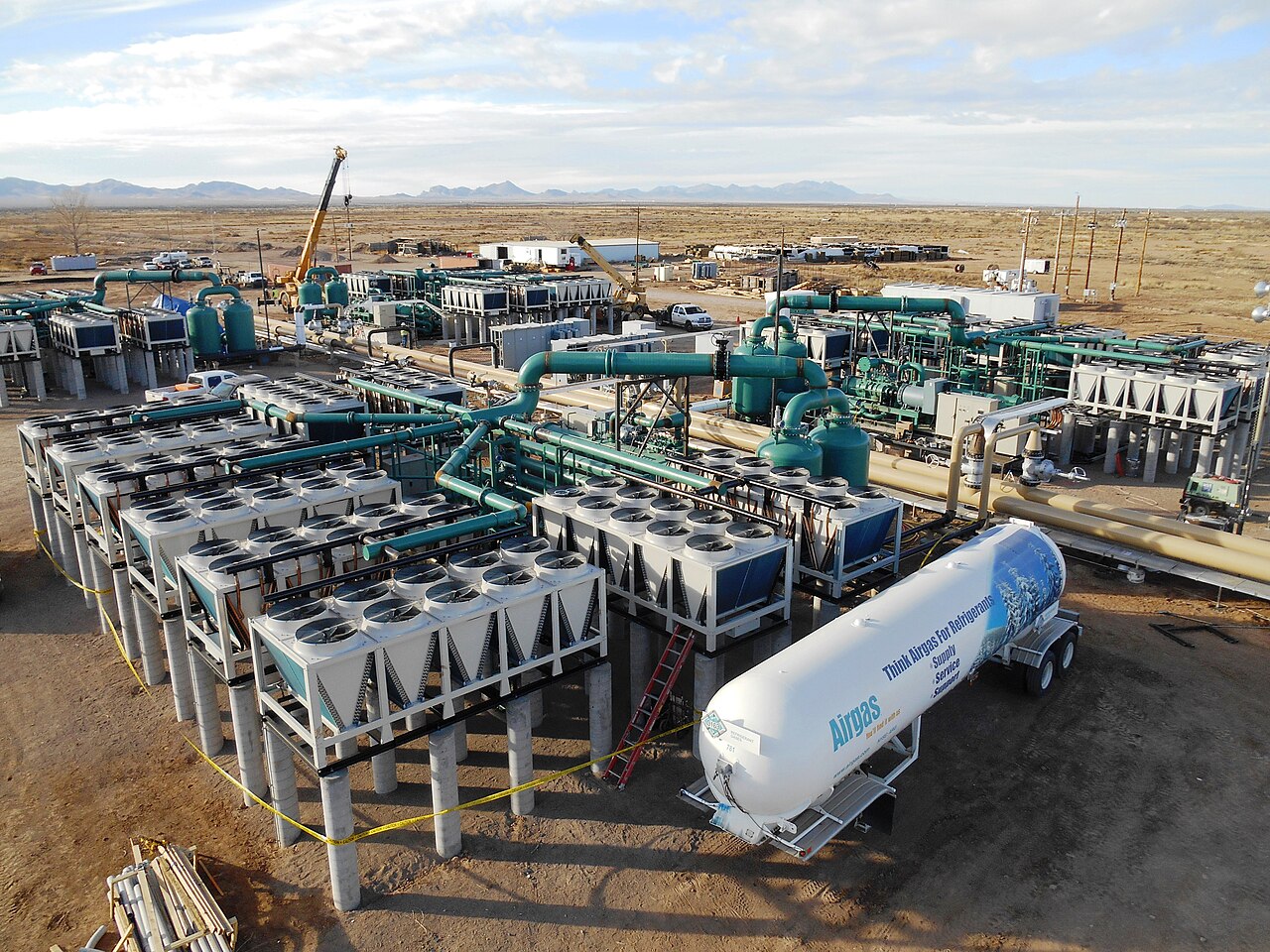
Zero is not on the slider on purpose. Capture designs top out around 90 to 95%; the longest-running power-plant unit, Boundary Dam, captured 848,388 tonnes in 2024 at 85% availability against a 1-million-tonne design, so the slider starts at 90, not 95[64][65]. Use before storage: curing concrete with CO₂ and making carbonate aggregate are commercial (690,000 tonnes mineralized worldwide to date; one aggregate plant takes 5,000 tonnes a year)[67][68], so the use slider starts at 10% and grows only as buyers sign; the pipeline to storage is the fallback, not the plan, and Process 4 shrinks the whole stream every year. The rest reaches zero by blending renewable gas and hydrogen, which Bloom hardware runs on[51], plus verified removals; HB93 already requires net-zero by 2045[1]. Storage depth: CO₂ stays a dense fluid below about 800 m / 2,625 ft under impermeable cap rock[52]. New Mexico has no permitted Class VI wells yet, so the realistic path is a pipeline to Permian Basin storage[53].
Not written for you? Change reader ↑
Sources for this process (17)
- [3] Draft Statement of Basis, NSR Permit 10883 — YGI Microgrid. New Mexico Environment Department, Air Quality Bureau, July 29, 2026. link ↗
- [4] Amended Notice of Public Hearing, AQB 26-57(P), NSR 10883. New Mexico Environment Department, Aug. 12, 2026. link ↗
- [14] Empowering Data Centers with 24x7 Decarbonized Power: The Role of Solid Oxide Fuel Cells. Bloom Energy (sponsored), Data Center Frontier, 2025. link ↗
- [15] Bloom Energy and Chart Industries Announce Groundbreaking Carbon Capture Partnership. Bloom Energy, 2024. link ↗
- [2] Project Jupiter — Building Responsibly (presentation to the Board of County Commissioners). Oracle / STACK Infrastructure, presented to Doña Ana County, July 28, 2026. link ↗
- [29] Emissions comparison used in permit comments (Albuquerque + Las Cruces ≈ 6.7 Mt CO₂e/yr). New Energy Economy / public comments on NSR 10883, 2026. link ↗
- [1] Project Jupiter Community Benefits Agreement (executed). Doña Ana County / Red Chiles A–D LLC / Yucca Growth Infrastructure LLC, Nov. 12, 2025. link ↗
- [47] National Ambient Air Quality Standards for Ozone (2015): 70 parts per billion, 8-hour. U.S. EPA / Harvard EELP tracker, 2015, retained 2020 and 2024. link ↗
- [49] Air Plan Approval; New Mexico; Periodic Emission Inventory SIP for the Sunland Park Nonattainment Area for the 2015 Ozone NAAQS. Federal Register (U.S. EPA), July 3, 2024. link ↗
- [52] Geologic Sequestration of Carbon Dioxide in Deep Saline Formations (response to comments). U.S. EPA, Underground Injection Control program, Jan. 2025. link ↗
- [51] Bloom Energy Server data sheet and technology page: natural gas, biogas, hydrogen, or blends. Bloom Energy, accessed Sept. 2026. link ↗
- [64] BD3 Status Update: Q4 2024 (848,388 tonnes captured in 2024; 85% availability). SaskPower, 2025. link ↗
- [65] Carbon capture at Boundary Dam 3 still an underperforming failure. Institute for Energy Economics and Financial Analysis, 2024. link ↗
- [67] CarbonCure hits 10 million low-carbon concrete truckloads; more than 690,000 tonnes of CO₂ mineralized. Carbon Herald / CarbonCure, Nov. 2025. link ↗
- [68] Blue Planet announces net-zero concrete placement using synthetic limestone aggregate; 5,000 tonnes CO₂/yr expansion. Blue Planet Systems, Feb. 2025. link ↗
- [56] Induced Earthquakes: Myths and Misconceptions. U.S. Geological Survey, Earthquake Hazards Program, accessed Sept. 2, 2026. link ↗
- [57] Illinois Basin – Decatur Project: one million tonnes of CO₂ stored, with microseismic monitoring. U.S. Department of Energy / Illinois State Geological Survey (Midwest Geological Sequestration Consortium), 2011–2014, reports through 2021. link ↗
Salty groundwater in, clean water out
Net gain for humanity ·5 million gallons a day of clean water made from water nobody could drink, added to the town's pipes.
Tap any part of the drawing for what it is and a photo. NEW marks what the upgrade adds.
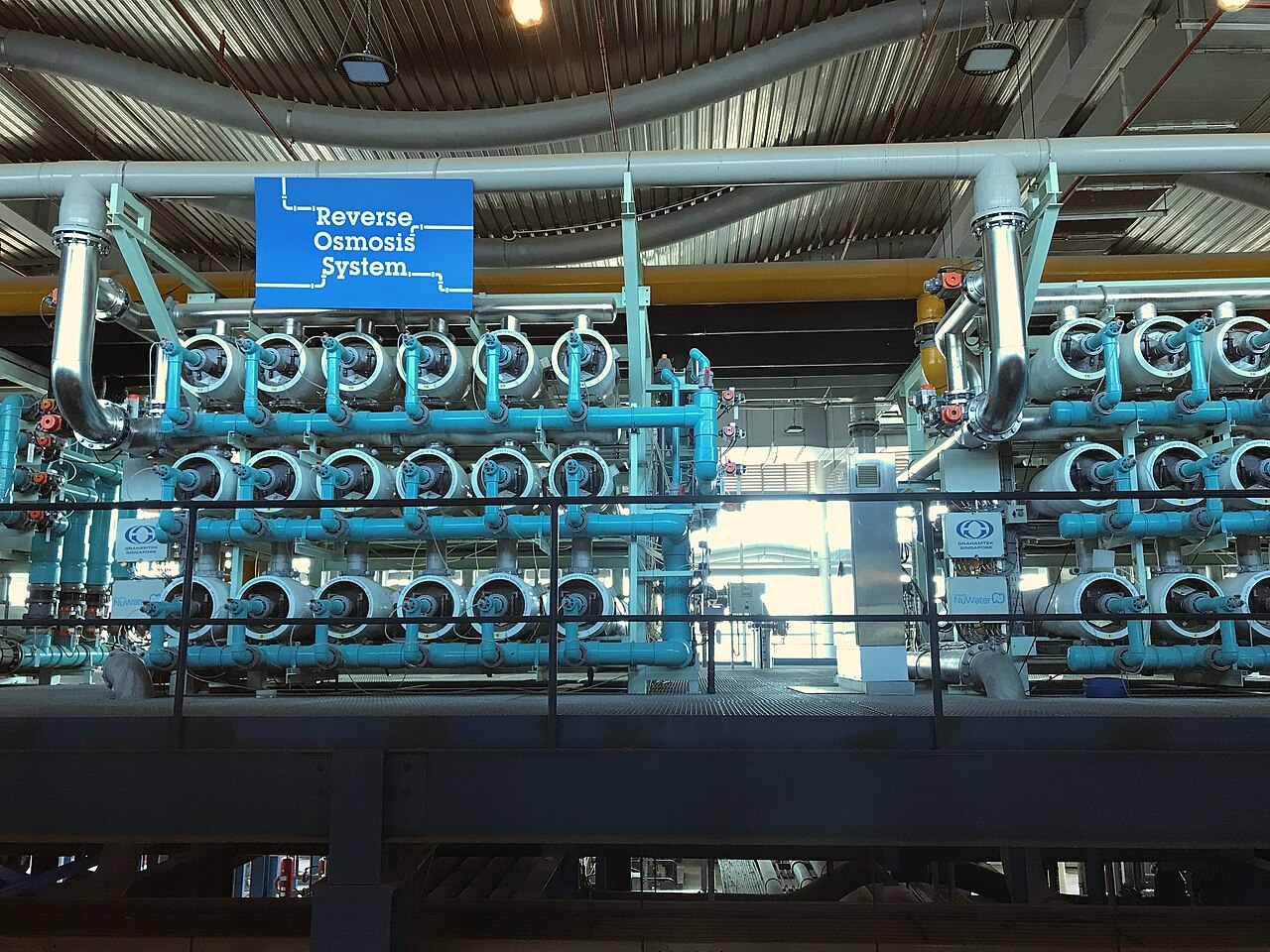
Brine does not have to be the end of the line: El Paso's board approved recovering about 3 MGD of drinking water and minerals from its KBH brine in 2026[66], and a brine concentrator run on summer server heat would cut the injected volume by half or more (an estimate with a real energy cost)[71][72]. Costs interpolate NMSU's 2023 figures for 1, 5 and 10 MGD plants and scale to the whole system using the study's 5 MGD ratio. Well count and home count are illustrative. Reverse osmosis is the proven method; server heat is a helper, not the engine. The county is already paying $250,000 to study a desalination plant[1]; the plan asks them to fund the one NMSU designed.
Not written for you? Change reader ↑
Sources for this process (10)
- [9] Water Desalination Feasibility Study for Santa Teresa (Dr. Pei Xu, NMSU Civil Engineering). NMSU / New Mexico Water Resources Research Institute, report M36 (also presented to the Legislature's Science, Technology & Telecommunications Committee), Oct. 31, 2023. link ↗
- [17] Desalination — Kay Bailey Hutchison Desalination Plant. El Paso Water, accessed Sept. 1, 2026. link ↗
- [18] El Paso Water Utilities Kay Bailey Hutchison Desalination Plant (Worth Its Salt). Texas Water Development Board, Jan. 2014. link ↗
- [19] Center for the Development and Use of Alternative Water Supplies / Brackish Groundwater National Desalination Research Facility. NMSU Water Resources Research Institute, accessed Sept. 1, 2026. link ↗
- [1] Project Jupiter Community Benefits Agreement (executed). Doña Ana County / Red Chiles A–D LLC / Yucca Growth Infrastructure LLC, Nov. 12, 2025. link ↗
- [5] Project Jupiter Together — FAQs. Project Jupiter Together (paid for by Oracle and STACK Infrastructure), accessed Sept. 2, 2026. link ↗
- [34] Project Jupiter will use more water than previously disclosed. Haussamen (Heath Haussamen), April 9, 2026. link ↗
- [33] New Mexico Supreme Court Asked to Stop Illegal Water Use for Project Jupiter Construction. Center for Biological Diversity, Aug. 20, 2026. link ↗
- [46] How We Use Water. U.S. EPA WaterSense, accessed Sept. 2026. link ↗
- [55] Monitoring Network of the Groundwater Flow System and Stream-Aquifer Relations in the Mesilla Basin. U.S. Geological Survey, New Mexico Water Science Center, accessed Sept. 2026. link ↗
Solar on the roofs, geothermal in the ground, wind on the wire
Net gain for humanity ·every hour the fuel cells rest is an hour of no exhaust, and those hours grow every year.
Tap any part of the drawing for what it is and a photo. NEW marks what the upgrade adds.
This bar is where the electricity comes from on an average hour
- 1. Main data center roof9.2 MW
- 2. North-west hall roof3.9 MW
- 3. North-east hall roof3.4 MW
- 4. East hall roof4.6 MW
- 5. Warehouse roof1.5 MW
- 6. Operations roof1.2 MW
- 7. Parking canopy1.0 MW
- 8. ¼ of greenhouse roof (semi-transparent)proposed5.7 MW
Geothermal is counted at a 90% capacity factor and delivered wind and solar at 40%, both typical, and the fuel cells are assumed to throttle in proportion; the "gas hours" figure is that average expressed as full-load hours, an estimate. Enhanced geothermal is itself deep injection of water and carries the same induced-seismicity rules as any injection well[56]; the difference is zero exhaust and power around the clock. Roof areas other than the halls are scaled from the render. Rooftop solar alone is about 1% of the load, and this card says so instead of hiding it.
Not written for you? Change reader ↑
Sources for this process (12)
- [41] Signs point to start of construction at $165 billion Project Jupiter AI data center. KTSM / Border Report, 2025. link ↗
- [4] Amended Notice of Public Hearing, AQB 26-57(P), NSR 10883. New Mexico Environment Department, Aug. 12, 2026. link ↗
- [6] Project Jupiter Site Render, Labeled (media gallery). Project Jupiter Together, Aug. 27, 2026. link ↗
- [1] Project Jupiter Community Benefits Agreement (executed). Doña Ana County / Red Chiles A–D LLC / Yucca Growth Infrastructure LLC, Nov. 12, 2025. link ↗
- [54] Solar Photovoltaic System Cost Benchmarks (Q1 2024). U.S. Department of Energy, Solar Energy Technologies Office / NREL, 2024. link ↗
- [58] Turboden on its repowering of the Lightning Dock geothermal plant in New Mexico. ThinkGeoEnergy / Turboden, 2019 (plant online Dec. 2018). link ↗
- [59] Geothermal low-temperature reservoir assessment in northern Doña Ana County, New Mexico (NMERDI final report). New Mexico Energy Research and Development Institute / OSTI, 1985. link ↗
- [60] Developing New Mexico's Geothermal Heat and Electricity (Water and Natural Resources Committee handout). New Mexico Legislature, Nov. 7, 2023, Nov. 7, 2023. link ↗
- [61] Fervo Energy breaks ground on the world's largest next-gen geothermal project; Cape Station 100 MW in 2026, 500 MW by 2028. Fervo Energy / Utility Dive / Canary Media, 2024–2026. link ↗
- [62] Fervo Energy and Google sign 396 MW PPA. Fervo Energy, Sept. 1, 2026. link ↗
- [63] Largest wind farm in the United States slated to begin commercial operations (SunZia, 3,650 MW, New Mexico). U.S. Energy Information Administration, Today in Energy, 2026. link ↗
- [3] Draft Statement of Basis, NSR Permit 10883 — YGI Microgrid. New Mexico Environment Department, Air Quality Bureau, July 29, 2026. link ↗
Greenhouses next to the dry coolers
Net gain for humanity ·about 60 million pounds of local food a year and about 3,000 permanent jobs on land that was going to sit empty.
Tap any part of the drawing for what it is and a photo. NEW marks what the upgrade adds.
Every figure on the upgraded card except the job commitment and the CO₂ purity is an industry average, not a Santa Teresa study. The site is about 819 acres with 400 in the first phase[1]; the developers have not published which acres are unbuilt, so the greenhouse acreage and location are a proposal to be set from their site plan, not a claim.
Also feasible here, not the plan: robotic vertical farms (Japan, China), with the numbers
Two working examples. Techno Farm Keihanna (Spread Co., Kyoto) grows about 30,000 heads of lettuce a day in stacked trays; robots seed, move and harvest, an IoT system tunes light, temperature and nutrients, the farm runs at a 99% operating rate and recycles over 90% of its water[25]. Chengdu (Chinese Academy of Agricultural Sciences, 2023): a 20-layer, 8.8-metre plant factory on a 100-square-metre footprint where robot arms do everything from seeding to packing; lettuce in 35 days, about 50 tonnes a year, the output of roughly 4 hectares of field[26].
The catch is electricity.Today's vertical farms use about 10–18 kWh per kilogram of lettuce against about 3.8 for a Dutch greenhouse; the best measured cases reach 3–7[27]. LEDs cannot use the site's waste heat, so on this campus every vertical-farm kilowatt is a gas kilowatt until Process 4 retires it. That is why the plan is glass greenhouses on free heat first, with vertical farms as a phase-two option once clean power is on the wire[28].
| Measure | Glass greenhouses (the plan) | Robotic vertical farm (feasible) |
|---|---|---|
| Food per acre | ~400,000 lb/yr, industry average | Roughly 10× a greenhouse per acre of floor (stacked layers); ~1% of field land for the same crop |
| Money for business owners | Lease + heat revenue ~$130k/acre/yr (estimate); grower capital ~$3M/acre | Higher output per acre; higher capital and power bills per kg; cost-competitive only with cheap clean power |
| Money for the county | ~6.5 jobs/acre incl. packing → ~1,000 jobs on 150 acres; taxable leases | Far fewer jobs per pound (robots); more output tax base per acre; fewer wages |
| Time to first harvest | Blocks of ~50 acres, about a year each (estimate) | Modular; a factory unit in under a year (Chengdu built in months) |
| Net gain to humanity now | Free heat used, CO₂ used, ~60M lb local food, jobs | More food per acre, but paid for in gas-fired electricity on this site today |
| In 50 years | Heat and CO₂ supplied as long as the campus runs; greenhouses re-glazed every 20–30 years | If power is clean by then (HB93 says 2045), the higher-output path; energy per kg is the deciding number |
| In 100 years | Land stays farmable; the campus lease has ended and returned to the tax rolls | Same land, more food per acre, fewer hands; both paths leave the aquifer and the air better than the plan as filed |
Estimates are labeled. Vertical-farm figures are from the two cited farms and the energy benchmarking literature, not from a Santa Teresa design. The 50- and 100-year lines are the direction the cited numbers point, not forecasts.
Not written for you? Change reader ↑
Sources for this process (5)
- [1] Project Jupiter Community Benefits Agreement (executed). Doña Ana County / Red Chiles A–D LLC / Yucca Growth Infrastructure LLC, Nov. 12, 2025. link ↗
- [30] What you need to know as Doña Ana commissioners set to vote on $165 billion Project Jupiter. El Paso Matters, Sept. 16, 2025. link ↗
- [3] Draft Statement of Basis, NSR Permit 10883 — YGI Microgrid. New Mexico Environment Department, Air Quality Bureau, July 29, 2026. link ↗
- [20] A Swedish data centre helping grow vegetables. Sweden.se (Swedish Institute), 2025. link ↗
- [8] Water Usage: Efficiency and Sustainability for Doña Ana's Future. Project Jupiter Together, Feb. 2026. link ↗
WHAT IT COSTS AND WHO PAYSForce Upgrade
What it costs and who pays: about 1.5% on top of the $165 billion bond. Most of it is the developer's, and the greenhouses are the growers' money, not the county's.
| Item | Cost | % of $165B | Who pays | Basis |
|---|---|---|---|---|
| Carbon-capture on 2,462 MW of fuel cells (2,275 stacks, manifolded by cluster) | $1.5B | 0.91% | Developer (Oracle / STACK / BorderPlex) | Order-of-magnitude estimate for concentrated-stream capture; exhaust is ~95% CO₂ per NMED [3]. Includes compression. No vendor quote exists. |
| NMSU-designed 5 MGD desalination system | $269M | 0.16% | Developer, delivered to CRRUA / county | 2023 NMSU figure for the whole system: wells, plant, storage, brine injection wells, lines [9]. The CBA already funds a $250,000 desalination study [1]. |
| Plate heat exchanger, pumps, insulated header to greenhouses | $60M | 0.04% | Developer | Standard district-heating hardware. Pays back in avoided fan and chiller electricity. |
| ~150 acres of glass greenhouses (proposed) | $450M | 0.27% | Commercial growers (leaseholders) | About $3M per acre for high-tech Venlo glass, industry average. Off the developer's balance sheet. Acreage depends on the unpublished site plan. |
| Roof and canopy solar (~25–35 MW peak) | $45M | 0.03% | Developer | Scaled from the reported 3 million sq ft of halls [33]. Runs the community side of the campus. |
| NMSU / DACC institute endowment | $50M | 0.03% | Developer | On top of the CBA's Exhibit B payments, which total $11.4M including $4.5M of building-permit fee offsets [1]. |
| Packing house, produce road, public gate | $25M | 0.02% | Growers and developer | Keeps farm trucks off the secure entrance. |
Their original text for this section is hidden ·
THE TIMELINE, YEAR BY YEAR
The same year marks as the net-gain section on the home page. Tap a year to see what is built, what is running, and what the county has in hand by then under the upgraded plan.
Their plan, as filed, and the record
What has actually happened: Nov. 12, 2025, Doña Ana County and the developers sign the Community Benefits Agreement alongside $165B in industrial revenue bonds [1]. Oct. 23, 2025, an emergency well authorization is issued; more than 103 million gallons are pumped April–August 2026 [25]. March and July 15, 2026, the State Land Office denies the pipeline's state-land segment [10]. July 2, 2026, four legislators propose a statewide data-center moratorium for 2027 [34]. July 28, 2026, the developers report 2,755 workers and 9% construction progress [2]. July 29, 2026, NMED publishes the draft air permit: 2,462 MW, 10,144,115 tons of CO₂e a year [3]. Aug. 24, 2026, the Supreme Court stays the air-permit hearing and the well; Sept. 1, 2026, it refuses to lift the stay [24][23]. The county reports missed quarterly job reports [32].
Under the force-upgraded plan
Built
Concrete is being poured (9% complete, their figure). Air permit and construction well are stayed by the Supreme Court.
Running
Nothing yet.
In the county's hands
Conditions written into the county IRB leases: capture before power-on, one permit, heat offered to growers, NMSU plant funded, bonds tied to verified jobs.
Sources for the timeline
- [1] Project Jupiter Community Benefits Agreement (executed). Doña Ana County / Red Chiles A–D LLC / Yucca Growth Infrastructure LLC, Nov. 12, 2025. link ↗
- [2] Project Jupiter — Building Responsibly (presentation to the Board of County Commissioners). Oracle / STACK Infrastructure, presented to Doña Ana County, July 28, 2026. link ↗
- [3] Draft Statement of Basis, NSR Permit 10883 — YGI Microgrid. New Mexico Environment Department, Air Quality Bureau, July 29, 2026. link ↗
- [33] New Mexico Supreme Court Asked to Stop Illegal Water Use for Project Jupiter Construction. Center for Biological Diversity, Aug. 20, 2026. link ↗
- [10] Commissioner Garcia Richard Again Denies Request to Run Portion of Project Jupiter Pipeline Through State Lands. New Mexico State Land Office, July 15, 2026. link ↗
- [42] New Mexico lawmakers announce proposed statewide moratorium on data centers. Source New Mexico, July 2, 2026. link ↗
- [43] Project Jupiter: where the AI data center project stands in NM. The Daily Lobo, Aug. 2026. link ↗
- [32] New Mexico Supreme Court puts Project Jupiter air proceeding, emergency well authorization on hold. New Mexico Political Report, Aug. 24, 2026. link ↗
- [31] New Mexico Supreme Court keeps Project Jupiter air permit on hold. Albuquerque Journal, Sept. 1, 2026. link ↗
- [40] Doña Ana County: Project Jupiter developers miss job reporting deadlines. Albuquerque Journal, 2026. link ↗
- [9] Water Desalination Feasibility Study for Santa Teresa (Dr. Pei Xu, NMSU Civil Engineering). NMSU / New Mexico Water Resources Research Institute, report M36 (also presented to the Legislature's Science, Technology & Telecommunications Committee), Oct. 31, 2023. link ↗
- [51] Bloom Energy Server data sheet and technology page: natural gas, biogas, hydrogen, or blends. Bloom Energy, accessed Sept. 2026. link ↗
Cumulative water and payment figures are the plan's own targets multiplied by years, labeled “about”. Their dates (Q4 2026 first operations, Q3 2028 first phase, 2031 matching, 2045 HB93 net-zero) are from their filings.
Their original text for this section is hidden ·
THE RECEIPTSUpgrade
Bloom Energy's own materials: about ten times the CO₂ concentration of a gas turbine, in one fifteenth the gas volume. Bloom and Chart Industries announced a carbon-capture partnership for exactly this stream.
Bloom / Chart announcement ↗Air Quality Permit application 10883 (Yucca Growth Infrastructure) to the New Mexico Environment Department, with greenhouse gas estimates of roughly 10 million tons a year and NOx split across microgrid permits.
NMED permit 10883 ↗Dr. Pei Xu, NMSU Civil Engineering, to the Legislature's Science, Technology and Telecommunications Committee, Oct. 31, 2023: 5 MGD brackish RO for Santa Teresa, 75% recovery, $115.5M plant, $269M system, brine to deep injection wells. Mesilla Basin holds ~65 million acre-feet of recoverable water.
NMSU study (PDF) ↗El Paso's Kay Bailey Hutchison plant has treated Hueco Bolson brackish water since 2007 at 27.5 MGD, piping brine 22 miles to three injection wells. It is 30 miles from Santa Teresa.
El Paso Water ↗Every building in our plan is in the position shown on Project Jupiter Together's labeled site render dated Aug. 27, 2026. We add nothing inside their fence.
Their labeled render ↗Gothenburg, Sweden runs a greenhouse on data center heat with the city energy company. Dutch policy pushes data centers to supply heat networks. Equinix's Paris PA10 grows produce on the roof.
Sweden.se ↗The agreement between the developers and Doña Ana County requires 2,500 construction workers and 750 full-time workers once operational. The 7,000 and 1,500 figures on their website are marketing projections, not obligations.
El Paso Matters ↗On Sept. 1, 2026 the New Mexico Supreme Court unanimously denied the developers' bid to partially reopen the air-permit proceeding. The Sept. 14 hearing on Permit 10883 will not happen while the stay stands.
Albuquerque Journal ↗The New Mexico Supreme Court stayed the air-permit proceeding and an emergency well authorization in August 2026. The State Land Office has denied the pipeline route twice.
NM Political Report ↗HELP IMPROVE THIS PLAN
Everything on this site is public record or published research, assembled by one NMSU computer-science student in a few days of reading. That is not enough people, and no one here claims these are the best possible ideas. If you are an engineer, a grower, a water operator, a lawyer, a Bloom or Oracle employee, a neighbor in Sunland Park, or a legislator, and you see a flaw, a better method, a missing source, or a cheaper way to reach the same result, send it. Corrections are welcome and will be posted with credit.
If Project Jupiter goes ahead, the goal is not to fight it forever. It is to make it the project New Mexico should have been offered in the first place: one that works with the county instead of on top of it.